How the polls stand around the world: six elections to watch
From November 2026 to April 2027 there are 22 elections around the world. From a dead heat between blocs in New Zealand to Bukele’s third term, this is what the polls say and what we forecast.
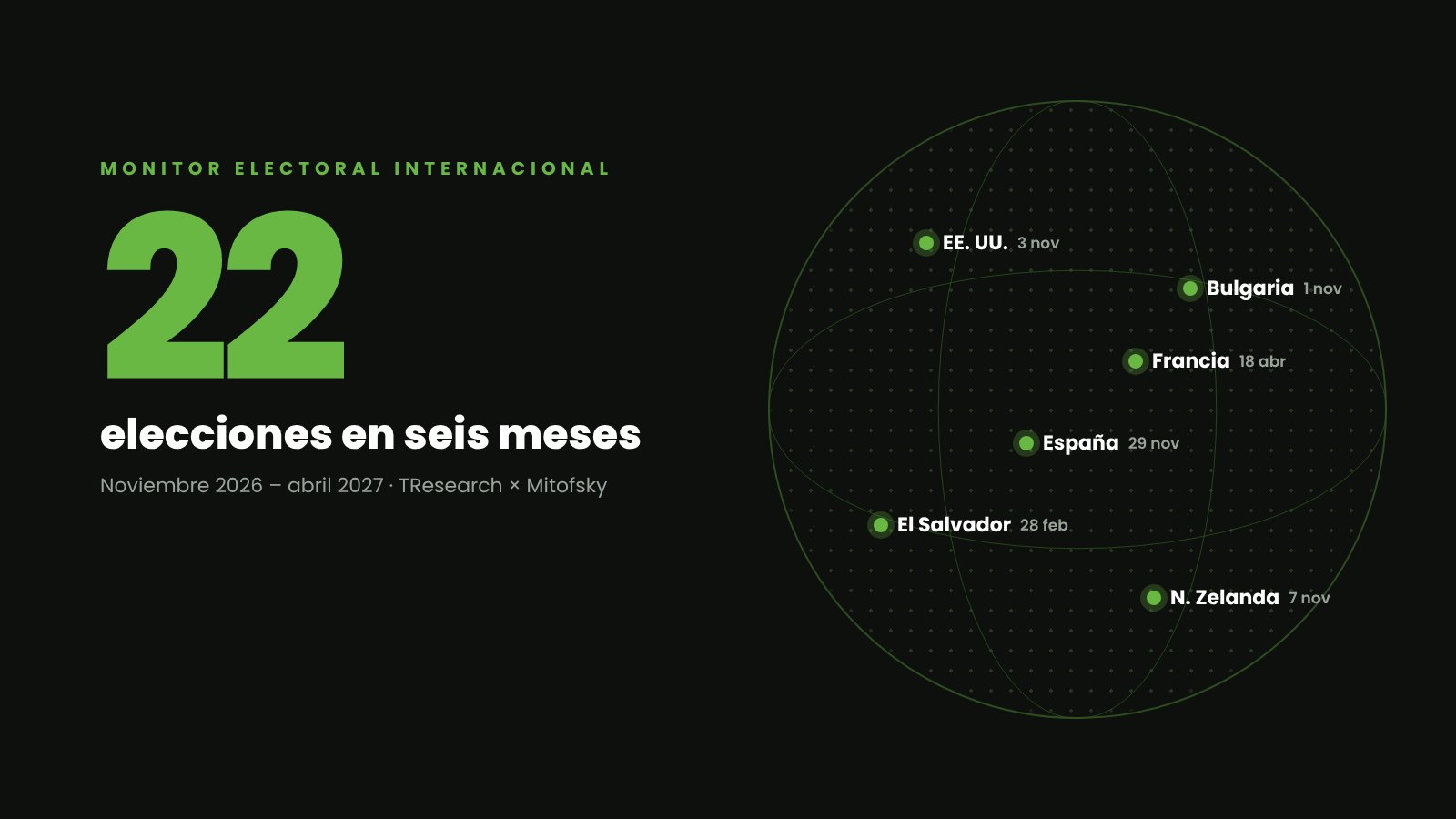
Over the next six months there will be 22 relevant elections around the world, from Bulgaria’s presidential runoff today, November 1, to the French first round expected on April 18, 2027. Six of them hold much of what is at stake for Western democracies and for Latin America, and those are the ones we follow closely: Bulgaria, the United States, New Zealand, Spain, El Salvador and France. On the radar are Mexico’s midterm and judicial elections, on June 6, 2027, and a possible election rerun in Israel.
The calendar is busy from the start. Besides the United States, November brings local elections in South Africa (4), general elections in Grenada (5) and New Zealand (7), Cape Verde’s presidential vote and Slovenia’s local elections (15), Taiwan’s local elections and the Victoria state election in Australia (28), and Spain’s general election and Swiss federal referendums (29). In December, Gambia (5), Guinea-Bissau (6), Haiti (13) and South Sudan (22) vote, and Serbia must hold a snap presidential election by the 27th. In 2027, Nigeria opens the year (January 16), followed by Kyrgyzstan (January 27), El Salvador (February 28), Estonia (March 7) and, on April 18, France and Finland.
November 2026
BulgariaPresidential runoff
U.S.Midterms
South AfricaLocal
GrenadaGeneral
New ZealandGeneral
Cape VerdePresidential
SloveniaLocal
TaiwanLocal
AustraliaState · Victoria
SpainGeneral
SwitzerlandFederal referendums
December 2026
GambiaPresidential
Guinea-BissauGeneral*
HaitiPresident & Congress
South SudanGeneral*
SerbiaSnap presidential*
January 2027
NigeriaPresident & Congress
KyrgyzstanPresidential
February 2027
El SalvadorPresidential & legislative
March 2027
EstoniaParliament
April 2027
FrancePresidential · 1st round*
FinlandParliament*
New Zealand: Opportunity decides
The November 7 election is the closest of the half-year. The 1News–Verian poll (October 15–19, 1,003 interviews, ±3.1 points) puts Prime Minister Christopher Luxon’s National Party at 32%, four points up from the previous poll; Chris Hipkins’ Labour at 27%; the Greens at 16%; ACT at 11%; NZ First at 8% and Opportunity at 7%.
In seats, the center-right bloc (National 38, ACT 13 and NZ First 9) adds up to 60, and the center-left bloc (Labour 32, Greens 19 and Te Pāti Māori 1) also reaches 60 when Opportunity’s 8 are added. A majority is 61. If Te Pāti Māori won five electorates, Parliament would grow to 124 seats and the left with Opportunity would reach 64. Luxon is preferred prime minister with 20%, against 17% for Hipkins. Our forecast: a coin toss. National leads, but no bloc reaches 61 on its own.
Coin toss: National leads, but no bloc reaches 61 on its own.
CertaintySpain: Feijóo, with Vox
Spain votes on November 29 in a snap general election. The average of ten seat projections gives the PP 134, the PSOE 108, Vox 67, Frente Amplio 9 and Podemos 2. PP and Vox would add up to 201, well above the absolute majority of 176. The PSOE is up three seats since October 15, but it is not enough. Pollsters agree on the direction: NC Report gives the PP 142 seats, the PSOE 101 and Vox 65; SocioMétrica, 135, 108 and 63; Sigma Dos, 128, 106 and 68. Our forecast: a change of government, led by Alberto Núñez Feijóo with Vox as a necessary partner.
142
101
65
135
108
63
128
106
68
Change of government: Feijóo, with Vox. The PSOE gains, but falls short.
CertaintyEl Salvador: Bukele goes for a third term
On February 28 El Salvador elects its president and Assembly under the rules of the 2025 constitutional reform: a six-year term, indefinite reelection and a single round decided by simple majority. Nayib Bukele, the top-rated leader in the Mitofsky ranking, arrives with 90% approval in TResearch’s poll (September 28 to October 2), 92% in CID Gallup, 94% in Data Poll and 85.5% in LPG Datos.
Data Poll shows 88% presidential vote intention for Nuevas Ideas; LPG Datos, 55%, with 20% undecided. Running against Bukele are Mayteé Iraheta (ARENA), Rafael Aguirre (FMLN), Alirio García Flamenco (PCN) and Orlando del Cid (FPS). The campaign began on October 27 and ticket registration closes on November 19. The country’s main problem, for 48.7% of Salvadorans, is the economy (TResearch). Our forecast: reelection is all but certain; the question is how much smaller an opposition that now holds 6 of 60 seats becomes.
Reelection all but certain; the question is how much the opposition shrinks.
CertaintyFrance: Le Pen leads; Mélenchon second
France will hold the first round of its presidential election, expected on April 18, 2027, with Marine Le Pen as the favorite in every scenario. The Ifop-Fiducial barometer (October 17–19) gives her 36% in the first round, assuming Édouard Philippe as the centrist candidate; Jean-Luc Mélenchon rises to second with 16.5%, followed by Philippe (15%) and Raphaël Glucksmann (14%). Depending on who runs, Le Pen ranges between 34% and 38%.
In a runoff, Le Pen would beat Philippe 56-44, Glucksmann 57-43, Gabriel Attal 58-42 and Mélenchon 68-32. Our forecast: Le Pen leads every head-to-head; second place remains open, and it will decide how competitive the final round, expected on May 2, turns out to be.
Le Pen leads every head-to-head; second place is still open.
CertaintyThe scorecard: holding ourselves accountable
Of our three most recent forecasts, we got one right. In Israel we anticipated a deadlock with no 61-seat majority, and that is what happened: the largest bloc stopped at 53. We missed in Brazil, where we expected a narrow win for Flávio Bolsonaro and Lula won by 3.6 points, and in Serbia, where we saw a coin toss with the SNS barely ahead and the students won by 13. In both cases, late deciders and turnout moved toward change more than the final polls captured: a warning for everything ahead.
We saidFlávio, narrowly
ResultLula won +3.6
MissWe saidCoin toss (SNS barely ahead)
ResultStudents +13
MissWe saidDeadlock: no one at 61
ResultDeadlock · 53/61
HitOur favorites for what comes next: in Bulgaria, Iliana Yotova, by a slight margin (she led the first round by 3 to 4 points, according to exit polls); in the United States, a Democratic House; in New Zealand, a coin toss; in Spain, Feijóo with Vox; in El Salvador, Bukele; and in France, Le Pen. The certainty we assign to each forecast is an analytical judgment by TResearch and Mitofsky, not a statistical probability, except in the United States, where we use the Decision Desk HQ model.
Bulgaria · todayYotova, slight edge
U.S. · Nov 3Democratic House
New Zealand · Nov 7Coin toss
Spain · Nov 29Feijóo, with Vox
El Salvador · Feb 28Bukele
France · Apr 18Le Pen
In Brazil and Serbia, the final week moved more votes than the polls captured: in change elections, the closing stretch and turnout matter as much as an early lead.
- IAPEE – Calendario electoral noviembre 2026 · 1 nov 2026
- IFES ElectionGuide · 1 nov 2026
- 1News–Verian poll · 15–19 oct 2026
- Demócrata – media de encuestas · 27 oct 2026
- Infobae (NC Report, SocioMétrica, Sigma Dos; TResearch El Salvador) · oct 2026
- CID Gallup n.º 129 · sep 2026
- Ifop-Fiducial – barómetro presidencial, ola 7 · 20 oct 2026
- TSE El Salvador · oct 2026
 FOCUS courtesy space
 Latino media and ad techLatino media and ad technology in one company.U.S. Latino Media, the Smadex programmatic platform and the Adwake performance agency.entravision.com →


